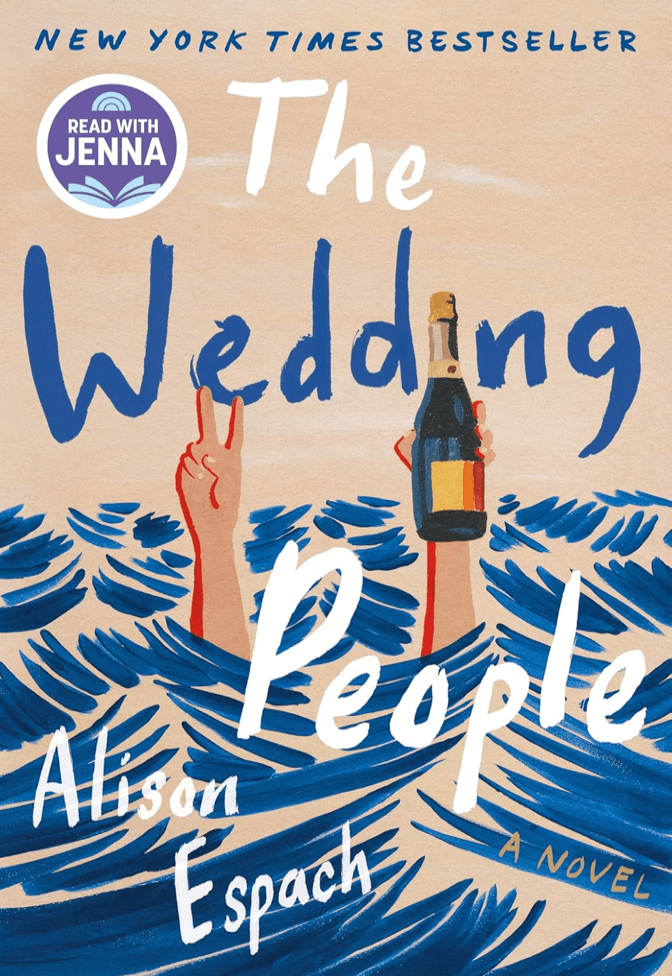
I didn’t come to The Wedding People with many expectations, except a vague curiosity stirred by its title. It immediately signaled a shift away from romance-centered wedding novels. Instead of focusing on the bride-and-groom love story, this book is about the people who orbit weddings—the brides, the mother-in law, the guests, and the onlookers. The cover design, too, stood out: one hand making a peace sign, another holding a champagne flute while drowning. It’s darkly comic and unmistakably millennial—cool without being disposable, stylish without being shallow.
What I found inside far surpassed my expectations. This book elevated fiction and storytelling about weddings with its thoughtful focus on women’s friendships, long-term relationships, and how we celebrate (or don’t celebrate) the work it takes to sustain them.
The novel follows Phoebe, a woman who arrives at the Cornwall Inn with the intention of ending her life. She arrives wearing an emerald silk dress and gold shoes—for one last moment of beauty and spectacle. But instead of a quiet exit, she gets caught up in the whirlwind of a massive wedding for Lila, a woman she’s never met, whose relationship is brimming with confusion, anxiety, and an obscene amount of money. Through Lila’s chaotic wedding weekend, Phoebe’s emotional life is gradually lifted from the depths of depression to being alive again.
What initially grabbed my attention was the literary richness of the writing. Phoebe, a scholar of Victorian literature, relates her inner world through a web of references—from Jane Eyre, to Disney Princess stories to the psychological realism of Russian novels. Some I was familiar with (like Jane Eyre), others I wasn’t—but rather than alienating me, the intertextuality drew me in. It deepened the novel and mirrored Phoebe’s own internal tug-of-war between intellect and emotion, detachment and desire.
But what truly struck me were Phoebe’s reflections on her own marriage and the emotional undercurrents of wedding culture. As she observes the splendor of Lila’s million-dollar celebration, she remembers her own wedding:
“They got married in a public park, invited only their closest friends and family because they were suspicious of money, of grand gesture. The bigger the gesture, the emptier the feeling. The more wedding you need, the less happy you must be.” (Espach xx)
when she later admits: “The utter simplicity of [her] life felt crushing” (Espach, 32), it made me realize that there is this unnamed notion that when it comes to weddings, financial restraint signals authenticity. This novel gently asks its readers: what if the desire for beauty and splendor isn’t shallow? What if it’s human?
As someone who’s been shaped by academia, I couldn’t help but connect with Phoebe’s struggle. She earned her doctorate in Victorian literature. She devoted herself to ideas. And yet, at some point, she quietly let her own intellectual ambitions fade. It was easier to support her husband’s work than to fight for her own. He becomes a tenured professor; she remains an adjunct. Only after meeting Lila and being revived by the events of the wedding does Phoebe reconnect with her own creativity—and finds a subject to write about: Victorian weddings. This shift is a beautiful reminder about sustainable ways of producing scholarly work: She is no longer studying what’s “worthy” by scholarly standards. She’s writing about rituals, emotion, performance, beauty—subjects that have historically been dismissed as “feminine” and therefore trivial.
As Phoebe begins to re-engage with life, it’s the small, glittering details that mark her rebirth. She gets a dog instead of the intellectual’s usual cat. She lets herself wear bright clothes. She admits:
“She used to feel some kind of professional obligation to despise the stuff, but if she is being honest with herself, she likes putting on make-up” (Espach, 225–226).
There’s an unspoken pressure in academia—and in certain feminist circles—to reject anything expensive, decorative, or feminine as unserious. But The Wedding People challenges that narrative. It insists that joy, beauty, and connection are not antithetical to intellect; they’re vital to survival.
The book also avoids romanticizing weddings. Through Lila, we see how modern wedding culture has turned love into a high-stakes performance. Lila spends over a million dollars on her big day—not necessarily out of joy, but out of pressure. There’s pressure to prove her relationship is real, pressure to entertain, pressure to be moved at the “correct” moments. And the more money that’s spent, the more pressure there is for the wedding to live up to its cost.
Reading this book also made me reflect on my own feelings about weddings. I don’t want to make mine deliberately small and unspectacular just to prove that my love is “authentic.” But I also don’t want a spectacle that caters to Social Media. It’s a tightrope to walk—and The Wedding People gave me permission to acknowledge that complexity.
This novel is thoughtful, emotionally rich, and sharp in its cultural critique. The balance between plot and inner life is masterfully handled. The characters are dynamic, the stakes feel real, and the writing never condescends. I’d recommend this book to any woman planning a wedding, in a long-term relationship, or trying to find her way back to herself after losing faith in what her life was supposed to be.
For me, reading The Wedding People was like sipping champagne after slogging through the drudgery of literary theory—it felt indulgent, celebratory, and deeply earned.
Let me know in the comment section if you have read the book. If not, what are your thoughts on weddings and the balance between splendor and spectacle?
If you enjoyed this, take a look at this: Books on complicated marriages
 Ellie The Bride
One response to “In Review: The Wedding People – A Witty, Sharp, and Moving Meditation on Weddings, Womanhood, and Intellectual Life”
[…] If you enjoyed this post, read this next: In Review: The Wedding People by Alison Espach […]
LikeLike